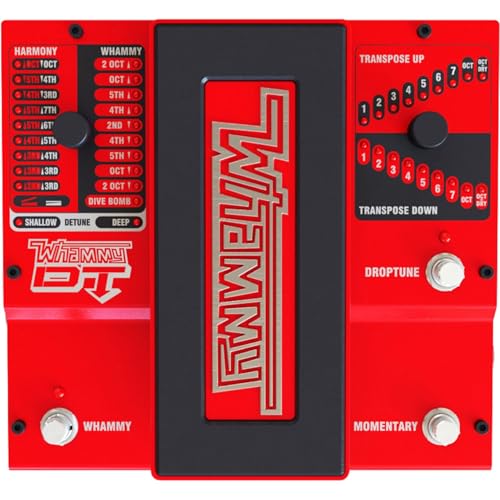
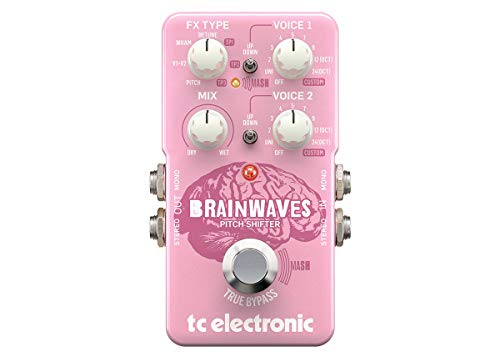
Choosing pitch & octave
Pitch-shifting pedals change the pitch of the input signal, usually by adding a note an octave above or below the one played. This category holds octave pedals, polyphonic pitch shifters and drop-tune effects, along with analog octave generators that produce synth-like tones.
Guitarists use these pedals for octave doubling, harmony and dropped tunings, and bass players use sub-octave units to add low range. The range divides first by tracking. Monophonic octave pedals shift one note at a time, while polyphonic units shift chords and several notes together. Shift ranges run from one octave to three octaves in either direction, and some pedals offer intervals from a fourth below to a third above.
Power and build also vary. Battery-powered pedals run without a supply on the board, while corded and adapter-powered units need a power source. Some models include a dry-signal control, and others offer switchable modes such as Vintage and Poly.
What to look for
- Polyphonic or monophonic pitch shifting
Polyphonic units track several notes at once, so a chord is shifted as a whole. Monophonic units track one note at a time. The choice determines whether chords shift together or only single notes are followed.
- Octave range and intervals
Some pedals shift up to three octaves in either direction, while others offer a range from a fourth below to a third above. The range sets which notes the effect can produce, so it is the main factor when matching a pedal to a playing style.
- Modes
Some octave pedals include Vintage and Poly modes, and others add a Detune or Harmony mode. Each mode changes how the shifted voice is produced, so a pedal with more modes covers more textures from one enclosure.
- Power requirement
Battery operation lets a pedal run without a power supply on the board. Corded electric and AC adapter models need a supply, and some units use DC power inputs. Power type affects where a pedal can be placed on a board.
Top pitch & octave in the reference
A reference list of well-documented models, not a ranking.


Notable models
- EarthQuaker Devices Rainbow Machine V2 Polyphonic Pitch Modulation. Its Pitch control runs from a fourth below the input to a third above, and it takes battery or DC power.
- Boss OC-3 Super Octave. A three-mode octave pedal with a separate bass input and a Polyphonic Octave mode for chords.
- MXR ® Poly Blue Octave. Four separately leveled octave divisions with polyphonic or monophonic shifting, plus fuzz and modulation.
- TC Electronic NETHER OCTAVER Classic All-Analog Octave. A classic all-analog octave pedal with battery power.
Frequently asked questions
What does a polyphonic pitch shifter do that a monophonic octave pedal does not?
A polyphonic pitch shifter tracks several notes at once, so a chord is shifted as a unit. A monophonic octave pedal follows one note at a time. The Electro-Harmonix POG2 Polyphonic Octave Generator and the Digitech DROP Compact Polyphonic Drop Tune Pitch-Shifter are built as polyphonic units.
Which pedals in this category are made for bass as well as guitar?
The Boss OC-5 Octave and the Boss XS-1 Poly Shifter Compact Pitch Shifting are designed for guitar and bass. The Boss OC-3 Super Octave includes a separate bass input.
How do pitch pedals in this category get power?
Several models run on battery power, including the Electro-Harmonix Nano POG Polyphonic Octave Generator and the EarthQuaker Devices Tentacle V2 Analog Octave Up. Others use an AC adapter or corded electric supply, such as the Boss OC-5 Octave, the Boss XS-1 Poly Shifter Compact Pitch Shifting and the Electro-Harmonix POG2 Polyphonic Octave Generator.
Which models in this category cover more than one octave?
The Boss XS-1 Poly Shifter Compact Pitch Shifting shifts up to three octaves in either direction. The Boss Oc-5 Octave And Effect has a three-octave range that includes octave up.
Sources: manufacturer specifications and GuitarTrader catalog data. Last verified October 24, 2026.