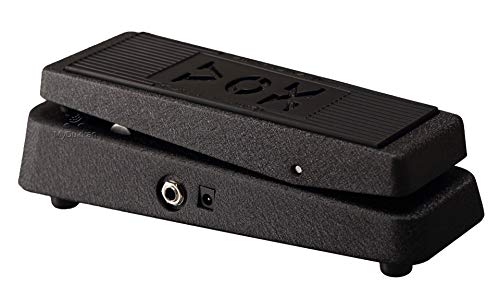
Dunlop Cry Baby® 95Q Wah
Guitar wah pedal with a Q control for frequency width, a boost of up to 15 dB, and auto-return switching.
Price and availability as of Nov 24, 2026, 1:57 AM PST, subject to change. As an Amazon Associate, GuitarTrader earns from qualifying purchases made through this link, at no additional cost to you.
Notice a mistake? Let us know
Overview
The Dunlop Cry Baby 95Q is a wah pedal for guitar, black in finish. It is built from the original Cry Baby wah with three additions: a Q control, a volume boost and auto-return switching. The Q control sets the width of the wah's frequency range, the volume control sets how much gain the boost adds, and the boost switch engages that gain. Power comes from a 9-volt battery, a 9-volt adapter, or a DC Brick, Iso-Brick or Mini Iso-Brick power supply. The pedal is bypassed when the foot is off it, and auto-return switching engages the wah when the foot is placed on the pedal. The maker describes the pedal as covering a range of wah character, from pronounced vocal tones to smoother tones.
Key features
- Q control that sets the width of the frequency range, with a narrower range clockwise and a wider range counterclockwise.
- Volume control that sets the gain added by the boost, up to 15 dB.
- Boost switch that engages the gain set by the volume control.
- Auto-return switching engages the effect when the foot is on the pedal and bypasses it, silently, when the foot is lifted.
- Input impedance of 1 megohm and output impedance of 1 kilohm.
- Bypass filter center frequency range of 390 Hz to 2 kHz.
- Buffered bypass.
- Draws 1.8 mA from a 9-volt DC supply.
Specifications · verified against the manufacturer
- Color / finish
- Black
Product identifiers
- Brand
- Dunlop
- Model
- Cry Baby® 95Q Wah
- Manufacturer model number
- 95Q
- UPC (GTIN-12)
- 710137017665
- ASIN (Amazon)
- B0002E4Y2E
- Category
- Filter, Wah & Envelope
- Manufacturer page
- jimdunlop.com
Dunlop Cry Baby® 95Q Wah — where it fits
Guitarists who want a wah with adjustable frequency width and a boost for lead passages, on a pedalboard that runs on a battery or an adapter.
Solo and lead passages
Engaging the boost and raising the volume control adds up to 15 dB of gain, which suits solo lines that need to stand out from the rhythm sound.
Rhythm and wah grooves
With the Q control set wider, the wah emphasizes lower harmonics. With it set narrower, higher harmonics come forward, which gives rhythm players a choice of wah shapes.
Expressive playing
Rocking the foot back and forth on the pedal produces the vocal, expressive tones that the Cry Baby line is known for.
Pedalboard with a shared supply
The pedal can run on a 9-volt battery, a 9-volt adapter, or a DC Brick, Iso-Brick or Mini Iso-Brick power supply, which suits a board that already has a power supply.
Stage use with auto-return
Auto-return switching engages the wah when the foot is on the pedal and silently bypasses it when the foot is lifted. That keeps the wah out of the signal between passages without a separate switch.
Worth knowing
- Power comes from a 9-volt battery or an external supply, and the DC Brick, Iso-Brick and Mini Iso-Brick supplies are not included. Running the pedal from an external supply means adding a separate power source to the pedalboard.
- Manufacturer product page: jimdunlop.com (accessed November 9, 2026)
- GuitarTrader catalog data
- Manufacturer owner's manual or spec sheet
Setup and compatibility
The battery is accessed through the bottom of the pedal. Set the volume and Q controls fully counterclockwise before playing. The pedal draws 1.8 mA at 9 volts DC.
Frequently asked questions
Can the 95Q run on a battery?
Yes. It is powered by a 9-volt battery accessed from the bottom of the pedal. A 9-volt adapter or a DC Brick power supply can also be used.
How does the Q control change the sound?
Turning the Q control clockwise narrows the frequency range to emphasize higher harmonics. Turning it counterclockwise widens the range to emphasize lower harmonics.
How much boost does the pedal add?
With the boost switch engaged, the boost range runs from 0.1 dB to 15 dB, set by the volume control.
Does the pedal bypass when the foot is off it?
Yes. Silent auto-off switching puts the pedal into bypass when the foot is lifted.
What are the input and output impedances?
The input impedance is 1 megohm and the output impedance is 1 kilohm.
How is the pedal connected in a signal chain?
Connect the guitar to the instrument jack and run a cable from the amplifier jack to the amplifier input.
More from Dunlop
All Dunlop gear →