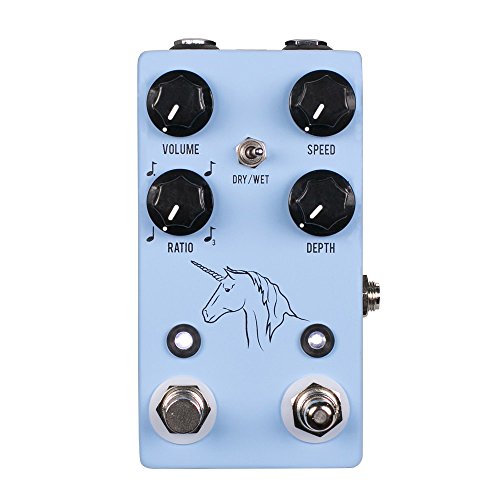
Dunlop MXR® Flanger/Doubler Effect
All-analog flanger and doubler effects pedal that recreates the original MXR rack unit in pedal form.
As an Amazon Associate, GuitarTrader earns from qualifying purchases made through this link, at no additional cost to you.
Notice a mistake? Let us know
Overview
The Dunlop MXR Flanger/Doubler is a guitar effects pedal, model M226, that the maker describes as a recreation of the original MXR rack unit in pedal form. It is an all-analog flanger and doubler built with bucket-brigade devices, and the maker describes its effects as classic sounds from recordings of the 1970s and 1980s. The pedal has two effect modes selected by a Doubler button, with Manual, Width, Speed, Regen, and Mix controls. An Invert switch reverses the polarity of the wet signal, and a footswitch toggles the effect on and off. CV In and CV Out jacks connect it to synths, sequencers, and CV-capable expression pedals. The maker describes the pedal as designed for experimenters.
Key features
- Flanger and doubler modes, selected by a Doubler button.
- Manual, Width, and Speed knobs that set the average delay time, the sweep range, and the sweep rate.
- Regen knob that controls feedback, from mellow coloration to metallic resonance.
- Mix knob that blends the wet and dry signals, from fully dry to fully wet.
- Invert switch that reverses the polarity of the wet signal.
- Two sweep LEDs that show the delay time at any moment.
Product identifiers
- Brand
- Dunlop
- Model
- MXR® Flanger/Doubler Effect
- Manufacturer model number
- M226
- UPC (GTIN-12)
- 710137146488
- ASIN (Amazon)
- B0HB1J8YPB
- Category
- Modulation
- Manufacturer page
- jimdunlop.com
Dunlop MXR® Flanger/Doubler Effect — where it fits
Guitarists who want flanger and doubler textures from one pedal, and players who want to connect control voltage from synths, sequencers, or expression pedals, as the maker describes.
Vintage flanger sweeps
In flanger mode, the pedal produces the jet-engine sweep and metallic resonance the maker describes. The Regen knob moves the feedback from smooth, mellow coloration to aggressive, metallic resonance.
Chorus, vibrato, and slapback
Doubler mode, engaged with the Doubler button, increases the delay time and covers chorusing, vibrato, and a short slapback delay. The Width and Speed knobs set the range and rate of the modulation in that mode.
Synth and CV control
The CV In jack accepts 0 to 5 V from synths, sequencers, or CV-capable expression pedals, and it bypasses the Manual, Width, and Speed knobs. The CV Out jack sends a 0 to 5 V signal from the internal LFO to control other devices.
Pedalboard use
A footswitch toggles the effect on and off, with a red LED showing when it is engaged. The pedal runs on a 9-volt supply, and the maker names the Dunlop ECB003 and the MXR Brick series as supplies for it.
Worth knowing
- The Doubler button increases the delay time for all settings. Settings chosen in flanger mode sound different once the Doubler button is engaged, because the delay time moves up in that mode.
- Flanger mode delay runs from 0.33 to 5.5 ms, and doubler mode delay runs from 14 to 66 ms. The two delay ranges do not overlap, so flanger sweeps stay below 5.5 ms while doubler chorus and slapback settings start at 14 ms.
- The CV In jack bypasses the Manual, Width, and Speed knobs. While a control voltage source is connected, those three knobs no longer set the sweep.
- The Input Level switch selects Line or Instr. level, and the two settings trade headroom for noise. Line Level gives more headroom for hot signals, and Instr. Level gives less noise for a guitar signal.
- Manufacturer product page: jimdunlop.com (accessed October 31, 2026)
- GuitarTrader catalog data
- Manufacturer owner's manual or spec sheet
Setup and compatibility
Powered by a 9-volt supply drawing 160 mA. The maker states the pedal cannot be powered by a battery, and names the Dunlop ECB003 and MXR Brick series supplies. The bypass is true bypass.
Frequently asked questions
Is the bypass true bypass?
Yes. The footswitch toggles the effect on and off, and a red LED shows when the effect is on.
What power does the pedal need?
It runs on a 9-volt supply and draws 160 mA. It cannot be powered by a battery.
Can the pedal be controlled by an external voltage?
Yes. The CV In jack accepts 0 to 5 V from synths, sequencers, or CV-capable expression pedals.
What is the difference between the flanger and doubler modes?
Flanger mode has a delay time from 0.33 to 5.5 ms and produces a jet-engine sweep. Doubler mode has a delay time from 14 to 66 ms and ranges from chorus and vibrato to slapback delay.
What does the Input Level switch change?
The Line setting gives more headroom for hot signals, and the Instr. setting gives less noise.
What does the Invert switch do?
It reverses the polarity of the wet signal, which changes the tone from a thin, hollow vocality to low-mid punch.
More from Dunlop
All Dunlop gear →


Similar modulation
All modulation →