JHS 3 Series Oil Can Delay
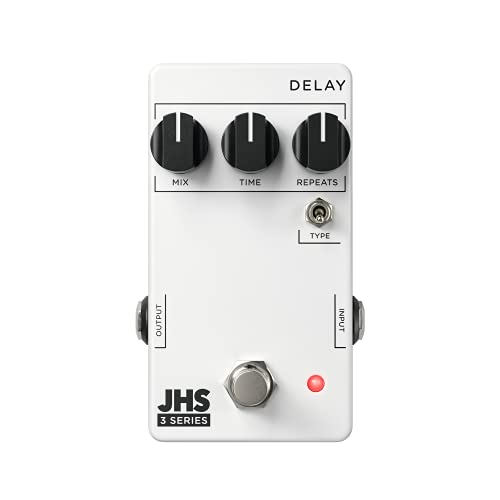
Oil can style delay pedal with Mix, Speed and Feedback controls and a toggle for modulation intensity.
As an Amazon Associate, GuitarTrader earns from qualifying purchases made through this link, at no additional cost to you.
Notice a mistake? Let us know
Overview
The JHS 3 Series Oil Can Delay is a delay pedal in the 3 Series line, which the maker describes as pedals with three simple controls and one toggle. It is modeled on the oil can delay, an electro-static echo design that the maker traces to a patent submitted in 1959. The maker describes the oil can echo as having elements of vibrato and slapback. According to the maker, the pedal is made in Kansas City, Missouri. The design began as a one-off built after a discussion with guitarist Nels Cline, and the pedal is not a signature artist model. The maker describes the earlier oil can units as using an oil-filled drum moved by a belt, with playback speed tied to the drum's rotation.
Key features
- A Mix control blends the echo with the clean signal, with the left setting giving less echo and the right giving more.
- A Speed control sets the delay time from 100 ms to 330 ms, with shorter times to the left and longer times to the right.
- A Feedback control sets the number of repeats, with less feedback to the left and more to the right.
- A toggle switches between two modulation intensities, with light movement in the down position and heavier movement in the up position.
- The input is a 1/4-inch jack on the right side of the pedal, and the output is a 1/4-inch jack on the left side.
Specifications · verified against the manufacturer
- Color / finish
- white
Product identifiers
- Brand
- JHS
- Model
- 3 Series Oil Can Delay
- Manufacturer model number
- OILCANDELAY
- UPC (GTIN-12)
- 650415212620
- ASIN (Amazon)
- B0DVCJVYGZ
- Category
- Delay
- Manufacturer page
- jhspedals.info
JHS 3 Series Oil Can Delay — where it fits
Guitar players who want an oil can style echo with vibrato and slapback character in a compact pedal with three knobs and one toggle.
Vibrato and slapback echo
The maker describes the oil can echo as having vibrato and slapback elements. The Mix and Feedback controls set how much echo is blended with the clean signal and how many repeats follow.
Pedalboard use with a 9 V supply
The pedal needs 9 V DC with negative center polarity. The 1/4-inch input and output connect it in a standard guitar chain.
Worth knowing
- Requires 9 V DC, negative center, drawing 65 mA. The maker advises against any supply above 9 V and says that using one would void the warranty.
- Delay time is set from 100 ms to 330 ms. Delay times outside that range cannot be set with the Speed control.
- The modulation speed is tied to the delay time. Short delay times give a faster modulation and long delay times a slower one, so the modulation rate cannot be set separately from the Speed control.
- Manufacturer product page: jhspedals.info (accessed October 31, 2026)
- GuitarTrader catalog data
Setup and compatibility
Requires 9 V DC with negative center polarity, drawing 65 mA. Do not use more than 9 V. The input and output are both 1/4-inch jacks.
Frequently asked questions
What power does the pedal need?
9 V DC with negative center polarity, drawing 65 mA. The maker says using more than 9 V voids the warranty.
What does the toggle switch do?
It switches between two modulation intensities. The down position gives light movement and the up position gives heavier movement.
What delay time range does the Speed control cover?
The Speed control sets the delay time from 100 ms to 330 ms, with shorter times to the left and longer times to the right.
Is the pedal a signature model?
No. The maker states that it is not a signature artist pedal.
Where are the input and output jacks?
The input is a 1/4-inch jack on the right side of the pedal, and the output is a 1/4-inch jack on the left side.