
JHS 3Series Rotary Chorus
Rotary chorus pedal with Intensity and Speed controls and a Room switch that adds a roomy reverb ambience.
As an Amazon Associate, GuitarTrader earns from qualifying purchases made through this link, at no additional cost to you.
Notice a mistake? Let us know
Overview
The JHS 3 Series Rotary Chorus is a guitar effects pedal that produces a rotating-speaker chorus tone. The Intensity control sets the modulation depth, and the Speed control sets how fast the simulated speaker spins. It is one pedal in the 3 Series line, which the maker says is made in Kansas City, Missouri, with three knob controls and one toggle per pedal. The Room toggle selects the standard effect when it is down and adds a roomy reverb ambience when it is up, which the maker compares to the room microphone sound of a real rotating speaker. The pedal runs on 9VDC negative center power and has a 1/4-inch input on the right side and output on the left.
Key features
- Intensity controls the modulation depth, with less at the left and more at the right.
- Speed controls the rate of modulation, with slower at the left and faster at the right.
- Volume controls the overall output level of the pedal.
- The Room toggle is the standard effect in the down position and adds a roomy reverb in the up position.
- The input is a 1/4-inch jack on the right side, and the output is a 1/4-inch jack on the left side.
Specifications · verified against the manufacturer
- Color / finish
- White
Product identifiers
- Brand
- JHS
- Model
- 3Series Rotary Chorus
- Manufacturer model number
- ROTARYCHORUS
- UPC (GTIN-12)
- 650415212781
- ASIN (Amazon)
- B0DVCHH7LN
- Category
- Modulation
- Manufacturer page
- jhspedals.info
JHS 3Series Rotary Chorus — where it fits
Suited to guitarists who want a rotating-speaker chorus tone from a single pedal, with a Room switch for added ambience.
Classic modulation tone
Intensity and Speed set the depth and rate of a spinning chorus, from a subtle movement to a deeper one. The maker describes the effect as a classic spinning chorus tone.
Ambient tones with the Room switch
Switching the Room toggle up adds a roomy reverb, which the maker describes as the ambient sound of a room microphone recording a real rotating speaker.
Front of an amp
The 1/4-inch input and output sit on opposite sides of the enclosure, so the pedal can be placed in the signal chain between the guitar and an amp.
Pedalboard use
The pedal runs on 9VDC negative center power at 65 mA, so it fits a pedalboard with a supply of that type.
Worth knowing
- The pedal is specified for 9VDC negative center power only. A battery-powered setup is not the stated power option for this pedal, and a battery-powered modulation pedal is a separate choice. See JHS 3 Series Flanger.
- The maker says the pedal should not be run above 9VDC, and doing so voids the warranty. The power supply must be rated at 9VDC with negative center polarity.
- The Room switch is the only reverb control, and it has no level adjustment. The amount of room ambience is either off or on, with no separate reverb level.
- The pedal provides a rotary chorus effect only. Other effects, such as delay or tremolo, need separate pedals.
Who should look elsewhere
- Battery operation for a modulation pedal. → JHS 3 Series Flanger
- A conventional analog chorus rather than a rotary-speaker tone. → JHS JHS Emperor V2 Analog Chorus
- A dedicated reverb pedal with its own controls. → JHS 3 Series Reverb
- Manufacturer product page: jhspedals.info (accessed November 9, 2026)
- GuitarTrader catalog data
Setup and compatibility
Requires 9VDC negative center power at 65 mA, and the maker says not to use more than 9VDC. The input and output are 1/4-inch jacks on opposite sides of the enclosure.
Frequently asked questions
What power does the pedal need?
It requires 9VDC negative center power and draws 65 mA.
What do the Intensity and Speed controls do?
Intensity sets the modulation depth, and Speed sets how fast the simulated speaker spins.
What does the Room switch do?
In the down position it is the standard effect. In the up position it adds a roomy reverb ambience.
Which side are the input and output jacks on?
The input is a 1/4-inch jack on the right side, and the output is a 1/4-inch jack on the left side.
Can the pedal be run on a higher voltage?
The pedal should not be run above 9VDC, and doing so voids the warranty.
More from JHS
All JHS gear →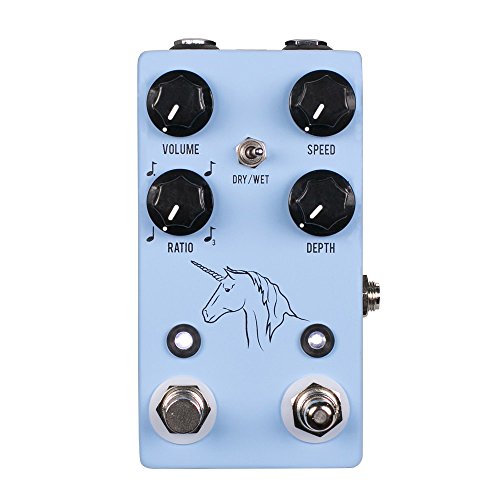


Similar modulation
All modulation →


