MXR ® EVH117 Flanger
Bucket-brigade flanger with an EVH switch that recalls preset values for classic EVH flanging.
Price and availability as of Nov 24, 2026, 1:58 AM PST, subject to change. As an Amazon Associate, GuitarTrader earns from qualifying purchases made through this link, at no additional cost to you.
Notice a mistake? Let us know
Overview
The MXR EVH117 Flanger is a guitar effects pedal built around bucket-brigade flanging. Four knobs, MANUAL, WIDTH, SPEED and REGEN, shape the phase-shifting sweep, and a footswitch toggles the effect on and off. What defines it is the EVH switch, which engages preset values for the classic EVH flanging sound and overrides the four knobs while it is pushed in. The maker places the pedal in its MXR line as the EVH-branded flanger, with a striped graphic finish in black, white and red. It is aimed at players who want the EVH flanging sound in a stompbox format, and it runs on two 9-volt batteries or an 18-volt adapter.
Key features
- The MANUAL knob sets the degree of phase shifting, with clockwise rotation emphasizing higher frequencies and counterclockwise rotation emphasizing lower frequencies.
- The WIDTH knob sets the intensity of the time delay, and the SPEED knob sets how fast that delay sweeps.
- The REGEN knob sets the overall intensity of the effect, which increases when the knob is turned clockwise.
- The sweep rate runs from 0.1 Hz to 10 Hz, with a maximum delay of 12.8 ms.
- The EVH switch, indicated by a yellow LED, engages preset values for classic EVH flanging and overrides the MANUAL, WIDTH, SPEED and REGEN controls.
- The footswitch toggles the effect on and bypass, and a blue LED indicates when the effect is on.
- The circuit uses bucket-brigade technology, which the maker describes as the same approach as its original flanger.
- The pedal has a striped finish in black, white and red with EVH graphics.
Specifications · verified against the manufacturer
- Color / finish
- black-and-white-and-red
Product identifiers
- Brand
- MXR
- Model
- ® EVH117 Flanger
- Manufacturer model number
- EVH117
- UPC (GTIN-12)
- 710137029651
- ASIN (Amazon)
- B0BK6SMLZ5, B000K6B13Y
- Category
- Modulation
- Manufacturer page
- jimdunlop.com
More than one number means the model is sold in more than one finish or version.
MXR ® EVH117 Flanger — where it fits
Guitar players who want a flanger with a switch-activated preset for classic EVH flanging, and who want the option of battery or adapter power. It fits a guitar signal chain running from the guitar into an amplifier.
Classic EVH flanging
Players who want the classic EVH flanging tone can push in the EVH switch, which sets the MANUAL, WIDTH, SPEED and REGEN controls to preset values. The switch makes the preset available without adjusting each knob.
Guitar into amplifier
The pedal sits between the guitar and the amplifier, with the guitar cable connected to the INPUT jack and a second cable running from the OUTPUT jack to the amp. The footswitch turns the effect on and off, and the blue LED shows the on state.
Custom flanger settings
Starting with all controls at 12 o'clock and the EVH switch disengaged, the player can shape the sweep with MANUAL for tonal emphasis, WIDTH for delay intensity, SPEED for sweep rate and REGEN for overall intensity.
Pedalboard with a power supply
The pedal accepts an 18-volt adapter or a DC Brick, Iso-Brick or Mini Iso-Brick power supply, which suits a pedalboard with a shared supply. Two 9-volt batteries cover setups without a supply.
Worth knowing
- The EVH switch overrides the MANUAL, WIDTH, SPEED and REGEN controls with preset values. While the switch is pushed in, turning those four knobs does not change the sound, so the switch must be released to adjust them.
- The adapter input is 18 volts, and the pedal also runs on two 9-volt batteries. A 9-volt supply does not match the 18-volt input, so a player without an 18-volt adapter or power brick runs the pedal from batteries. See MXR ® Analog Chorus.
- The batteries sit in a compartment accessed through the bottom of the pedal. Changing batteries means reaching the underside of the pedal, which is harder once it is fixed to a pedalboard.
- Manufacturer product page: jimdunlop.com (accessed October 21, 2026)
- GuitarTrader catalog data
- Manufacturer owner's manual or spec sheet
Setup and compatibility
The pedal runs on two 9-volt batteries accessed through the bottom of the pedal, or on an 18-volt adapter such as the Dunlop ECB004 or ECB004EU, or on a DC Brick, Iso-Brick or Mini Iso-Brick power supply. Current draw is 35 mA, and the bypass is hardwire. The guitar connects to the INPUT jack and the OUTPUT jack goes to the amplifier. The maker suggests starting with all controls at 12 o'clock and the EVH switch disengaged.
Frequently asked questions
Can the classic EVH flanging setting be recalled without adjusting the knobs?
Yes. Pushing in the EVH switch, which lights a yellow LED, engages preset values for classic EVH flanging and overrides the MANUAL, WIDTH, SPEED and REGEN controls.
What power options does the pedal accept?
The pedal runs on two 9-volt batteries accessed through the bottom of the pedal, or on an 18-volt adapter or a DC Brick, Iso-Brick or Mini Iso-Brick power supply.
Which way should the MANUAL knob be turned to emphasize lower frequencies?
Turning the MANUAL knob counterclockwise emphasizes lower frequencies, and turning it clockwise emphasizes higher frequencies.
How fast can the sweep be set?
The sweep rate runs from 0.1 Hz to 10 Hz, and turning the SPEED knob clockwise produces a faster phase effect.
What do the LEDs indicate?
The EVH switch LED is yellow and lights when the EVH setting is engaged. The footswitch LED is blue and lights when the effect is on.
Where should the controls start when the pedal is first set up?
The maker suggests starting with all controls at 12 o'clock and the EVH switch disengaged.
More from MXR
All MXR gear →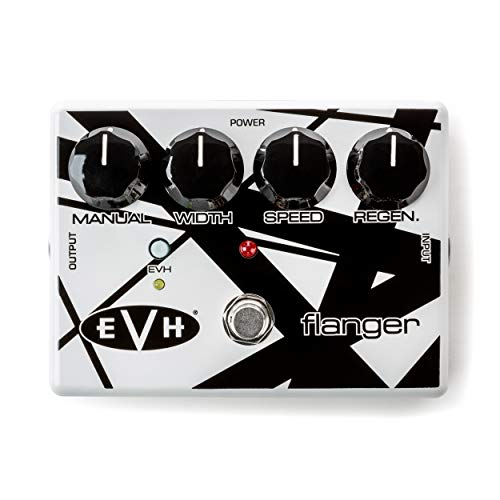


Similar modulation
All modulation →