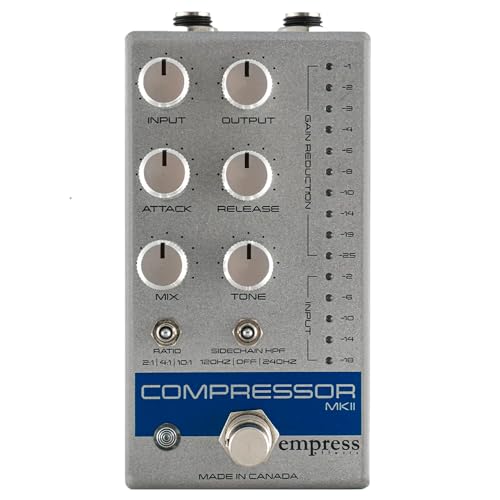
Origin Effects Cali76 FET Compressor
FET compressor pedal inspired by the Urei 1176 studio compressor, with a DRY blend control for parallel compression.
Price and availability as of Nov 24, 2026, 1:59 AM PST, subject to change. As an Amazon Associate, GuitarTrader earns from qualifying purchases made through this link, at no additional cost to you.
Notice a mistake? Let us know
Overview
The Origin Effects Cali76 FET Compressor is a compressor pedal with all-analog circuitry. The maker describes it as inspired by the Urei 1176 studio compressor and as using ultra-fast FET compression. It has dedicated attack, release and ratio controls, a DRY blend control and a 10-LED gain reduction meter. The maker describes the pedal as the latest in a long line of Cali76 compressors. It is designed and built in England and has a brushed aluminum finish. The maker recommends a regulated power supply designed for guitar pedal applications.
Key features
- All-analog signal path with FET compression, which the maker describes as ultra-fast.
- Dedicated attack, release and ratio controls.
- DRY blend control for parallel compression.
- 10-LED bar graph gain reduction meter.
- Circuitry inspired by the Urei 1176 studio compressor.
- Optimized for guitar and compatible with line-level signals.
- Buffered bypass.
- Brushed aluminum finish.
Specifications · verified against the manufacturer
- Color / finish
- Brushed Aluminium
Product identifiers
- Brand
- Origin Effects
- Model
- Cali76 FET Compressor
- Manufacturer model number
- CALI76FET
- ASIN (Amazon)
- B0G9BBX5TC, B0D2PG7193
- Category
- Compressors & Dynamics
- Manufacturer page
- origineffects.com
More than one number means the model is sold in more than one finish or version.
Origin Effects Cali76 FET Compressor — where it fits
Guitar players who want studio-style compression, including parallel compression, on a pedalboard or in a home studio.
Parallel compression on a pedalboard
The DRY control blends the uncompressed signal with the compressed signal. The maker describes parallel compression as a popular studio technique that the DRY control makes available on a pedalboard.
Placement in the signal chain
The maker says the pedal can stay clear anywhere in the signal chain. The gain reduction meter shows how much compression is being applied.
Line-level sources
The maker says the pedal works with line-level signals from keyboards and studio outboard gear.
Pedalboard and home studio use
The maker says the pedal can be used on a pedalboard and in a home studio.
Worth knowing
- Mains adaptor only, with no battery option. The pedal runs on a 9V DC supply with a 2.1 mm center-negative plug. The pedal cannot run on a battery, so a 9V DC power supply has to be set up on the pedalboard.
- Manufacturer product page: origineffects.com (accessed October 31, 2026)
- GuitarTrader catalog data
Setup and compatibility
The pedal runs on a 9V DC supply with a 2.1 mm center-negative plug, through a mains adaptor that is not included. Current draw is 200 mA. The maker recommends a regulated power supply designed for guitar pedal applications, because supplies without sufficient filtering can cause noise.
Frequently asked questions
What power does the pedal need?
A 9V DC supply with a 2.1 mm center-negative plug, through a mains adaptor that is not included.
Does the pedal have a battery option?
No. The maker has dispensed with the 9V battery option.
What is the current draw?
200 mA.
What are the input and output impedance?
Input impedance is 1 megaohm and output impedance is 1 kilohm.
What does the DRY control do?
It blends the dry signal with the compressed signal for parallel compression.
Can the pedal be used with line-level signals?
Yes. The maker says it is compatible with line-level signals from sources such as keyboards and studio outboard gear.
What does the meter show?
A 10-LED bar graph shows gain reduction.
More from Origin Effects
All Origin Effects gear →

Similar compressors & dynamics
All compressors & dynamics →