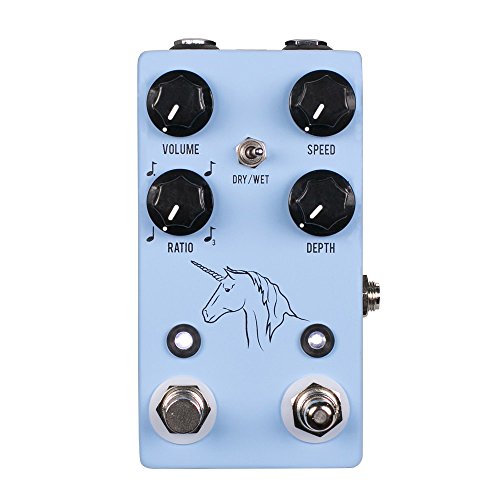
Walrus Audio Polychrome Analog Flanger
Analog flanger with a voice switch, a D-F-V blend knob and sine, triangle or random LFO shapes.
Price and availability as of Nov 24, 2026, 1:58 AM PST, subject to change. As an Amazon Associate, GuitarTrader earns from qualifying purchases made through this link, at no additional cost to you.
Notice a mistake? Let us know
Overview
The Walrus Audio Polychrome Analog Flanger is a guitar effects pedal in the modulation category, built around a true-bypass analog flanger circuit. Its controls are RATE, DEPTH, SWEEP and FEEDBACK knobs, a D-F-V blend knob, and voice and shape switches. The D-F-V knob blends the dry and delayed signal from full dry through traditional flange to pitch vibrato, and the voice switch selects between two flange voices. The maker says the layout controls are familiar from its other modulation pedals and presents this one as a colorful tool for adding modulated textures. It is aimed at players who want a wide range of flange sounds from one pedal, from traditional flanging to pitch vibrato.
Key features
- The RATE knob sets the LFO rate from 0.1 Hz at minimum to about 8 Hz at maximum.
- The DEPTH knob sets the depth of the LFO, which determines the width of the filter sweep, and it interacts with the SWEEP knob.
- The SWEEP knob shifts the frequency range the filtering applies to, with higher settings giving tighter, more traditional flange tones and lower settings giving deeper ones.
- The FEEDBACK knob sets how much of the affected signal cycles back through the circuit, with higher settings giving a more dramatic flanging effect.
- The D-F-V knob blends the dry and delayed signal, from full dry at minimum to traditional flange at noon and full pitch vibrato at maximum.
- The voice switch selects between a traditional, full-frequency flange in the down position and a more complex, notched flange with less low end in the up position.
- The shape switch selects a sine, triangle or random LFO wave to modulate the delay line.
- The bypass switch is true bypass, and pressing and holding it while the effect is off engages the effect temporarily.
Specifications · verified against the manufacturer
- Color / finish
- Random
Product identifiers
- Brand
- Walrus Audio
- Model
- Polychrome Analog Flanger
- Manufacturer model number
- 900-1059
- UPC (GTIN-12)
- 810424032866
- ASIN (Amazon)
- B094WX9Y4W
- Category
- Modulation
- Manufacturer page
- walrusaudio.com
Walrus Audio Polychrome Analog Flanger — where it fits
Guitar players who want several flange textures from a single pedal, including pitch vibrato, and who are comfortable setting a range of knobs and switches. The pedal fits a guitar signal chain that runs into an amplifier, on a pedalboard powered by a 9-volt DC supply.
Traditional flanging
With the voice switch in the down position and the SWEEP knob at higher settings, the flanger produces a traditional, full-frequency tone. Raising the FEEDBACK knob adds a more dramatic flanging effect.
Pitch vibrato
Setting the D-F-V knob to maximum, the FEEDBACK knob to a minimum and the voice switch up produces pitch vibrato. The maker highlights this use alongside the flanger sounds.
Pedalboard with an isolated supply
The pedal runs from a 9-volt DC, center-negative supply rated at 100 mA minimum. An isolated supply suits a pedalboard, since daisy-chained supplies are not recommended for this pedal.
Worth knowing
- In the up position, the voice switch gives a notched flange with less low end. Players who want full low end in the flange keep the voice switch in the down position.
- The pedal takes a 9-volt DC, center-negative supply rated at 100 mA minimum, and daisy-chained supplies are not recommended. The pedal needs its own isolated supply output rather than a shared, daisy-chained supply on the board.
- At low feedback settings the effect is subtle and sounds similar to a traditional chorus. A player who wants a stronger, more dramatic flange raises the feedback setting.
- Manufacturer product page: walrusaudio.com (accessed October 21, 2026)
- GuitarTrader catalog data
- Manufacturer owner's manual or spec sheet
Setup and compatibility
The pedal takes a 9-volt DC, center-negative supply rated at 100 mA minimum, and an isolated power supply is recommended. Daisy-chained power supplies are not recommended. The guitar connects to the input jack, the output jack goes to the amplifier or next pedal, and the bypass is true bypass.
Frequently asked questions
What power does the pedal need?
It takes a 9-volt DC supply with center-negative polarity rated at 100 mA minimum, and an isolated supply is recommended.
Can the pedal be powered from a daisy-chained supply?
Daisy-chained power supplies are not recommended for this pedal.
How does the SWEEP knob change the flange?
The SWEEP knob shifts the frequency range the filtering applies to, with higher settings giving tighter, more traditional flange tones and lower settings giving deeper flange tones.
How can the SWEEP knob produce notched filter effects?
With the DEPTH knob at zero and the D-F-V knob at noon, the SWEEP knob controls the parked position of the filter. Increasing the FEEDBACK knob makes the effect more dramatic.
How slow can the sweep rate go?
The RATE knob sets the LFO rate from 0.1 Hz at minimum to about 8 Hz at maximum.
What wave shapes can the LFO use?
The shape switch selects sine, triangle or random LFO wave to modulate the delay line.
What does the voice switch change?
In the down position the flanger is more traditional and full frequency. In the up position it is more complex and notched, with less low end.
More from Walrus Audio
All Walrus Audio gear →


Similar modulation
All modulation →