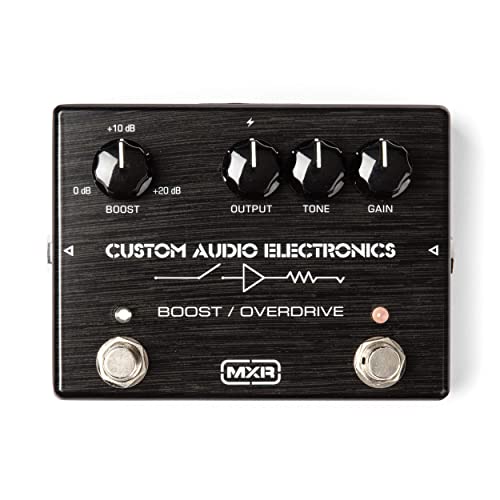
Choosing overdrive, distortion & fuzz
Overdrive, distortion and fuzz pedals all add gain, but they clip the signal in different ways. Overdrive adds a moderate amount of soft clipping, often with a midrange emphasis, and it responds to picking strength and guitar volume. Distortion clips harder and more consistently, with more compression and sustain, and it produces a saturated sound that depends less on the amplifier. Fuzz clips the signal toward a square-wave shape, and the transistor type and circuit family set whether the result sounds woolly, splatty or thick.
Models also differ in power, controls and bypass. Power options vary: some pedals run on a 9 V battery, some on a DC adapter, and some Ibanez models accept either. Controls range from a single tone knob to two-band and three-band EQ sections, and some bass-specific models add a balance or blend control so the dry signal can be mixed back in. Bypass type also varies, with true bypass and buffered designs represented.
What to look for
- Power requirement
Power requirement sets how the pedal is supplied. Some pedals run on a 9 V battery, some need a DC adapter, and some Ibanez models accept a battery or a DC 9 V center-negative adapter, so the supply on the board has to match.
- Tone controls
Tone controls range from a single tone knob to two-band and three-band EQ sections. A single knob shifts the overall brightness, while an EQ lets a player shape the low, middle and high ranges separately.
- Clean blend
Blend, mix and balance controls mix the unprocessed signal back into the output. The Behringer Overdrive Bod400 Authentic Tube-Sound Overdrive has a BALANCE control for this purpose, and the Tech 21 DUg Pinnick Signature Distortion has a Mix control. Blending in the dry signal keeps the fundamental of a bass note present under heavy gain.
- Bypass type
Bypass describes what happens to the signal when the pedal is off. True bypass routes the signal past the circuit with no buffer, and buffered bypass keeps a buffer in the path. The Electro-Harmonix Op Big Muff Pi Fuzz and the Wampler Belle Overdrive are described with true bypass.
- Clipping modes
Clipping modes and switches change the character within one enclosure. The JHS Kilt 10 Limited Overdrive and Fuzz selects four clipping settings with two toggles, and the Ibanez TS9DX Turbo Tube Screamer Overdrive offers Hot and Turbo modes for added low-end crunch.
Top overdrive, distortion & fuzz in the reference
A reference list of well-documented models, not a ranking.


Notable models
- Behringer Overdrive Bod400 Authentic Tube-Sound Overdrive. A battery-powered bass overdrive with a BALANCE control that mixes in the dry signal, designed for bass including 5- and 6-string models.
- Boss FZ-5 Fuzz. A battery-powered fuzz with COSM modeling of 1960s and 1970s fuzz tones and FUZZ, MODE and LEVEL controls.
- Ibanez TS9B Tube Screamer Overdrive. A bass-voiced Tube Screamer overdrive with Drive, Mix, Bass, Treble and Level controls.
Frequently asked questions
What separates overdrive from distortion?
Overdrive adds moderate soft clipping, often with a midrange emphasis, and it responds to picking strength and guitar volume. Distortion clips harder and more consistently, which produces a saturated sound that depends less on the amplifier.
How does a fuzz pedal differ from the other two types?
Fuzz clips the signal close to a square wave. The transistor type and circuit family shape the result, and fuzz pedals generally sit first in the signal chain, directly after the guitar.
Which pedals in this category are designed for bass?
The Boss ODB-3 Overdrive, the Tech 21 DUg Pinnick Signature Distortion and the Behringer Overdrive Bod400 Authentic Tube-Sound Overdrive are designed for bass. The Ibanez TS9B Tube Screamer Overdrive is bass-voiced.
How are these pedals powered?
Some pedals run on a 9 V battery, some need a DC adapter, and some Ibanez models accept either a battery or a DC 9 V adapter.
Sources: manufacturer specifications and GuitarTrader catalog data. Last verified October 24, 2026.