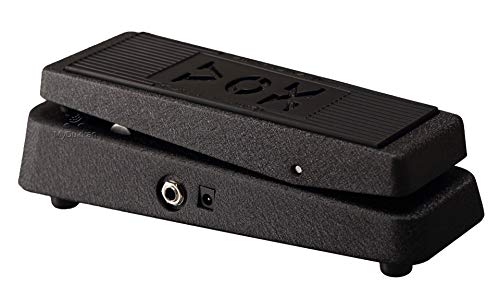
Dunlop Cry Baby® Mini 535Q Wah
Compact Cry Baby wah with four selectable sweep ranges, a Q control and a switchable boost.
Price and availability as of Nov 24, 2026, 1:57 AM PST, subject to change. As an Amazon Associate, GuitarTrader earns from qualifying purchases made through this link, at no additional cost to you.
Notice a mistake? Let us know
Overview
The Cry Baby Mini 535Q Wah is a compact wah pedal in Dunlop's Cry Baby line. Dunlop describes it as half the size of a standard wah and positions it for pedalboard efficiency. A four-position Range Selector sets the sweep band, from about 270 Hz to 1.3 kHz in position one up to about 420 Hz to 2.1 kHz in position four, and a Q control sets the width of the bandpass. The pedal includes a BOOST switch with an LED that lights when boost is active, and a VOLUME knob that sets boost up to 16 dB. It runs on a 9-volt battery or a 9-volt supply and is built for guitar. Dunlop describes the Range Selector as the way to set the tonal character of the sweep.
Key features
- A four-position Range Selector switch that chooses one of four frequency sweep ranges.
- A Q knob that adjusts the bandpass width, from narrow to wide.
- A BOOST switch and VOLUME knob that add up to 16 dB of boost, with an LED that shows when boost is active.
- A footswitch that toggles the effect on and off, with true hardwire bypass when the effect is off.
- An INSTRUMENT jack for the cable from the guitar and an AMPLIFIER jack for the cable to the amplifier.
Specifications · verified against the manufacturer
- Color / finish
- Black
Product identifiers
- Brand
- Dunlop
- Model
- Cry Baby® Mini 535Q Wah
- Manufacturer model number
- CBM535Q
- UPC (GTIN-12)
- 710137103436
- ASIN (Amazon)
- B079DWQTQT
- Category
- Filter, Wah & Envelope
- Manufacturer page
- jimdunlop.com
Dunlop Cry Baby® Mini 535Q Wah — where it fits
Guitar players who need a wah for a crowded pedalboard, with four sweep ranges and a boost. The pedal fits in front of an amp or on a board with a shared 9-volt supply.
Crowded pedalboard
At half the size of a standard wah, according to the maker, the pedal fits a board where room is limited.
Lead passages with boost
The boost adds up to 16 dB when engaged, and the LED next to the switch shows when the boost is active during a song.
Battery-powered rig
Battery power, installed through the bottom plate, suits a board that has no shared supply.
Between guitar and amp
One instrument cable runs from the guitar to the INSTRUMENT jack, and another from the AMPLIFIER jack to the amp input, so the pedal sits in the signal path before the amp.
Worth knowing
- The sweep offers four range positions. The tonal choices are fixed to four bands, so the Range Selector cannot be set to a band outside those four.
- The battery is installed through the bottom plate. A battery change means removing the bottom plate.
- The Brick-style power supplies are not included with the pedal. Running the pedal from an adapter rather than a battery requires a 9-volt supply bought separately.
- The pedal has one instrument input and one amplifier output, with no effects loop. Other pedals go in the chain before or after the wah.
- Manufacturer product page: jimdunlop.com (accessed October 21, 2026)
- GuitarTrader catalog data
- Manufacturer owner's manual or spec sheet
Setup and compatibility
Run an instrument cable from the guitar to the INSTRUMENT jack, and another from the AMPLIFIER jack to the amplifier input. The pedal runs on one 9-volt battery, installed through the bottom plate, or on an AC adapter such as the Dunlop ECB003. A DC Brick or Iso-Brick supply also works, and those supplies are not included. Current draw is 2.5 mA, input impedance is 1 MΩ and output impedance is about 1.5 kΩ. Push the toe of the pedal down until a click turns it on or off.
Frequently asked questions
How is the pedal powered?
It runs on one 9-volt battery, installed through the bottom plate, or on an AC adapter such as the Dunlop ECB003. The DC Brick and Iso-Brick supplies are not included.
How many sweep ranges does the pedal offer?
Four. Position one covers about 270 Hz to 1.3 kHz, and position four covers about 420 Hz to 2.1 kHz.
How does the Q knob change the sound?
Turning it clockwise narrows the bandpass to emphasize higher harmonics, and turning it counterclockwise widens the bandpass to emphasize lower harmonics.
How is the boost engaged?
The BOOST switch engages the boost, and the VOLUME knob sets the gain up to +16 dB. An LED lights when the boost is active.
More from Dunlop
All Dunlop gear →