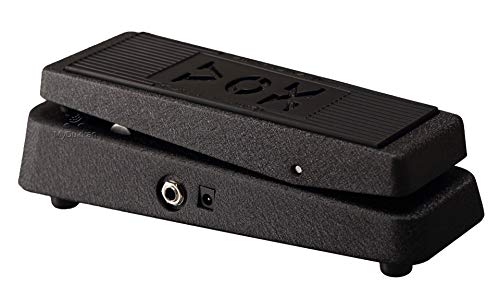
Dunlop Dimebag Cry Baby® From Hell Wah
Cry Baby wah developed with Dimebag Darrell, with a six-position range selector, switchable boost and a second output jack.
Price and availability as of Nov 24, 2026, 2:02 AM PST, subject to change. As an Amazon Associate, GuitarTrader earns from qualifying purchases made through this link, at no additional cost to you.
Notice a mistake? Let us know
Overview
The Dunlop Dimebag Cry Baby From Hell Wah is a wah pedal developed with Dimebag Darrell. The maker says it was built from the 535Q model, carrying over its Q control, six-position range selector and adjustable boost, and adding a wider sweep range, a toe-down frequency control, a second output jack and back-mounted LED indicators. The pedal has a VARIABLE Q knob, a FINE TUNE knob for the toe-down frequency, a VOLUME knob that sets boost gain, and a six-position RANGE SELECTOR for the center frequency of the wah. The maker describes the pedal as designed for players who need options on stage. It has a black camo finish and a rocker with adjustable tension, and the maker notes that the rocker tread is skateboard skid tape. The maker ties the pedal to the expressive sweep the Cry Baby wah is known for.
Key features
- A six-position RANGE SELECTOR sets the frequency center of the wah, and the maker describes the sweep as broader than standard wahs.
- The VARIABLE Q knob sets the width of the frequency band, with clockwise settings giving a narrower range that emphasizes higher harmonics.
- The FINE TUNE knob adjusts the toe-down frequency, with clockwise settings giving a brighter toe-down sound and counterclockwise settings a darker one.
- The BOOST switch engages a boost whose gain is set by the VOLUME knob, and a red LED shows when the boost is engaged.
- Back-mounted LEDs show the pedal's on or off state, with a green LED for on and a red LED for boost.
Specifications · verified against the manufacturer
- Color / finish
- Black
Product identifiers
- Brand
- Dunlop
- Model
- Dimebag Cry Baby® From Hell Wah
- Manufacturer model number
- DB01B
- UPC (GTIN-12)
- 710137116436
- ASIN (Amazon)
- B07VW3HWLS
- Category
- Filter, Wah & Envelope
- Manufacturer page
- jimdunlop.com
Dunlop Dimebag Cry Baby® From Hell Wah — where it fits
Guitarists who want a wah with a six-position range selector, a switchable boost and a second output jack for a split signal, on a stage or touring rig.
Lead lines with boost
The BOOST switch adds gain set by the VOLUME knob, for lead passages that need more output in the mix. The Q control and RANGE SELECTOR shape the wah around those leads.
High-gain riffs and wah sweeps
The Q control narrows the frequency band to emphasize higher harmonics, while a counterclockwise setting widens it to emphasize lower harmonics. The six range positions give different sweep centers.
Split signal to two effects chains
In the default parallel mode, the OUTPUT and OUTPUT/INPUT jacks both carry the affected signal, which suits splitting the signal to two chains.
Dry signal to a tuner
In pass-through mode, the OUTPUT/INPUT jack carries the clean signal, which suits sending the dry signal to a tuner outside the effects chain.
Tone shaping across the sweep
The RANGE SELECTOR, FINE TUNE and Q controls together set the toe-down tone from darker to brighter.
Worth knowing
- The power options are a 9-volt battery, the Dunlop ECB003 9-volt adapter, or DC Brick-type supplies, and the DC Brick-type supplies are not included. A board that uses a DC Brick-type supply needs that supply on hand, and a 9-volt battery or the ECB003 adapter covers the pedal without one.
- Parallel or pass-through operation of the OUTPUT/INPUT jack is set by an internal JP2 switch. The mode is changed inside the pedal rather than from a panel control.
- The boost gain is set by the VOLUME knob and applies only when the BOOST switch is engaged. The boost level depends on where the VOLUME knob is set, so the knob position controls how much gain the boost adds.
- Manufacturer product page: jimdunlop.com (accessed November 9, 2026)
- GuitarTrader catalog data
- Manufacturer owner's manual or spec sheet
Setup and compatibility
The pedal is powered by a 9-volt battery, accessed through the bottom of the pedal, the Dunlop ECB003 9-volt adapter, or a DC Brick-type supply. The DC Brick, Iso-Brick and Mini Iso-Brick supplies are not included. Current draw is 2.5 mA at 9 volts DC. Input impedance is 1 MΩ, output impedance is below 1 kΩ, and the bypass is buffered. The OUTPUT/INPUT jack works in parallel mode by default, or in pass-through mode when the internal JP2 switch is set down. Adjustable rocker tension is set under the heel with the included wrench.
Frequently asked questions
Can the wah be powered by a battery?
Yes. A 9-volt battery, accessed through the bottom of the pedal, powers it, as does the Dunlop ECB003 9-volt adapter or a DC Brick-type supply.
How is the boost level set?
The BOOST switch engages the boost, and the VOLUME knob sets how much gain the boost adds.
What does the VARIABLE Q knob change?
The Q control sets the width of the frequency band. Clockwise gives a narrower range that emphasizes higher harmonics, and counterclockwise gives a wider range that emphasizes lower harmonics.
Can the output be used to split the signal to two effects chains?
Yes. In the default parallel mode, the OUTPUT and OUTPUT/INPUT jacks both carry the affected signal, which suits splitting the signal to two chains.
How is the rocker tension adjusted?
An adjustable torque clutch under the rocker at the heel sets the resistance. Clockwise increases resistance, and counterclockwise decreases it. A wrench is included.
What does the FINE TUNE knob change?
The FINE TUNE knob adjusts the toe-down frequency, with clockwise giving a brighter toe-down sound and counterclockwise a darker one.
How can the player tell whether the pedal and boost are on?
Back-mounted LEDs show the status. A green LED indicates the pedal is on, and a red LED indicates the boost is engaged.
More from Dunlop
All Dunlop gear →